Appearance
Module 8 · Supervise the live floor
Leer en español: Módulo 8 · Supervisa el piso en vivo.
Goal: monitor a call in progress from the dashboard — listen, whisper to the agent, join three-way or take the call — and understand why every action leaves evidence. Time: ~7 minutes · You need: a running campaign with at least one connected call (Module 3) and a supervisor with their extension registered (their browser softphone or a SIP device).
1. The live monitor
Open Agents & Seats → Live Monitor (or the monitoring menu). You will see every human call in progress, with the agent, the state and the supervision controls:
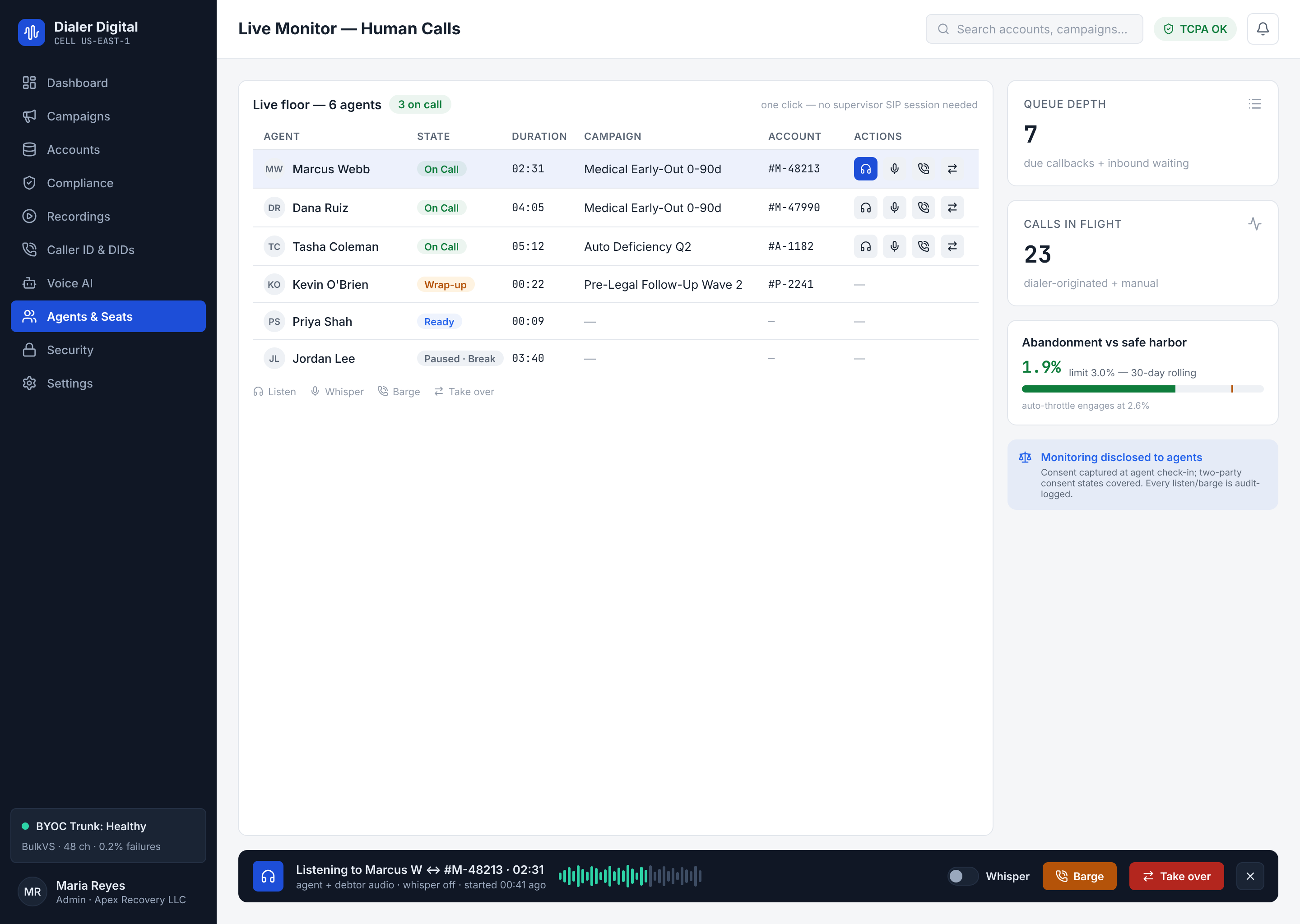
Numbers are masked
Just like the floor in Module 1, the monitor shows the debtor's phone to the last 4 digits (***0184). The full number never crosses this screen.
2. The four actions
Each live call gives you four modes. When you activate them, the supervisor's registered extension rings (their softphone) — answer within 20 seconds to join:
| Action | Who hears you | What for |
|---|---|---|
| Listen | nobody | Silent QA: you hear both sides without anyone noticing. |
| Whisper | only the agent | Live coaching: you tell the agent something and the debtor does not hear you. |
| Barge (three-way) | both sides | You join the conversation with both of them. |
| Take over (takeover) | — | You transfer the debtor to yourself and take the agent off the call. |
There is only one active mode per supervisor per call: changing mode is a new action — the previous leg is hung up and its close is recorded. There is no DTMF tone menu to change mode; everything goes through the dashboard, audited.
3. Why every click leaves a trace
Here is the difference from a common dialer: before sending any command to the switch, the platform writes a durable audit row. If the evidence cannot be written, the command is not sent (evidence-first, fail-closed).
- Every attempt — successful or failed — is recorded: who supervised, which call, which mode, when.
- Those rows travel inside the debt's Litigation Defense Packet (Module 4): "the supervisor started coaching on this call, at this time" is defensible years later.
If the action fails, it tells you — and does not pretend
If the call already ended or the supervisor's device is not registered, you will see a clear error (502/503). The action was not half-executed: either there is evidence and a command, or neither.
4. How it is used in practice
- The day's QA: silently listen to a few calls and take notes. Zero friction for the agent.
- Rescue a call: whisper to correct the agent without the debtor noticing; if it gets complicated, barge three-way.
- Close it yourself: takeover when the debtor asks to speak with a supervisor — the agent leaves and you stay on the call.
What you learned
- The four supervision actions and whom each one hears.
- That the switch only receives the order after the evidence is written.
- That every supervision is a durable row that defends your agency.
Continue with Module 9 — Protect your numbers to understand the health of your DIDs.